
Why Did a Pillar Fall on the Mumbai-Pune Expressway Just 9 Weeks After It Opened?
A ₹6,695-crore road met its first monsoon and lost. The gap between a ribbon-cutting and a real stress test is the whole story.
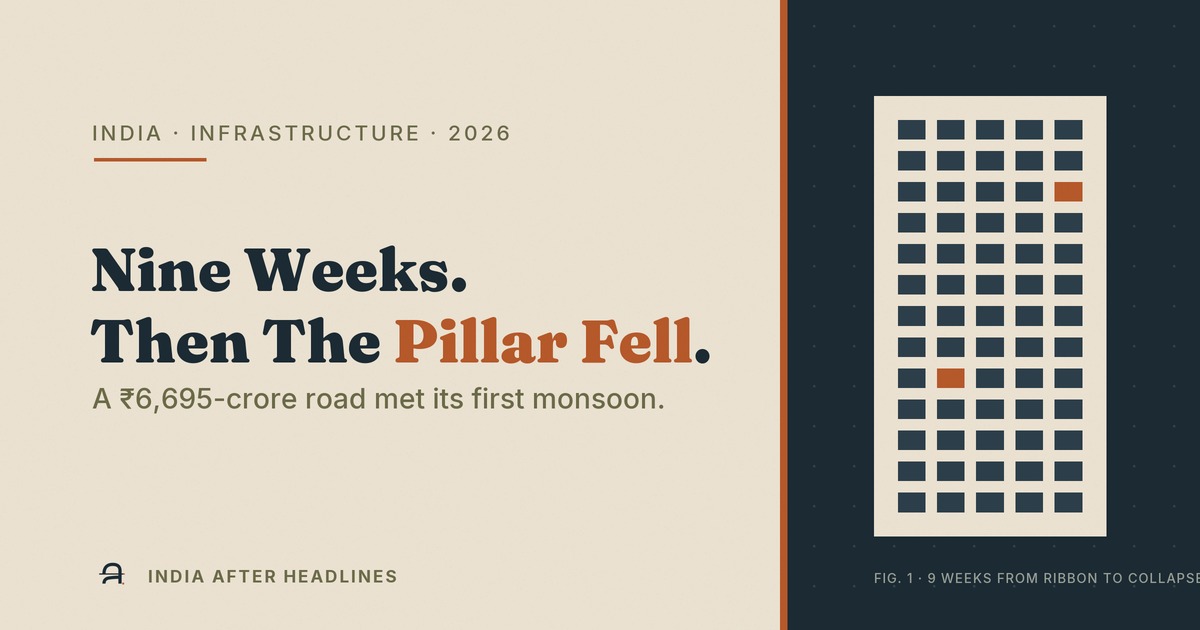
Short answer: On 6 July 2026, sustained monsoon rain triggered a landslide near the second tunnel of the Mumbai-Pune Expressway’s “Missing Link” — a 13.3-km, ₹6,695-crore shortcut connecting Khopoli and Lonavala — and a concrete pillar came down onto the carriageway. The expressway had been opened with full political fanfare only in May 2026. This was its first real monsoon, and it lasted nine weeks.
The ribbon took two minutes. The test took a whole monsoon.
Normally a new expressway earns its reputation slowly — years of traffic, a few seasons of rain, before anyone questions the build. This one didn’t get that long. The road was shut for more than 18 hours on 6 July before reopening the next night. Nine weeks, start to finish, from ribbon to rubble on its own carriageway.
Was this a one-off? No — three structures failed in one week.
If the Missing Link were the whole story, it would still be serious. It isn’t the whole story.
In the same 72-hour window: a stretch of NH-48 caved in near Gurugram, bad enough that companies issued a work-from-home advisory. And in Mumbai’s Mankhurd, an illegal three-storey chawl collapsed, killing 6 people — 5 of them children.
Three structures, three different mechanisms. The Missing Link was a brand-new, ₹6,695-crore government project. NH-48 is an old highway with a maintenance question hanging over it. The Mankhurd chawl never had approval to exist in the first place. Different causes, same underlying failure: nobody asked, in advance, whether any of these three could survive a full monsoon — until the monsoon itself administered the test.
Was it rushed for political optics? That’s an allegation, not a fact.
Opposition leaders say the Missing Link was pushed to completion ahead of the monsoon for ceremony value. That’s their claim, unproven. What’s not in dispute is the calendar: inaugurated in May, before the rains; failed structurally in July, during the rains. A ribbon-cutting date is a political decision. A pre-monsoon structural stress test is an engineering one. They don’t have to fall on the same day — but here, they didn’t fall far enough apart.
What does “force majeure” actually cover here?
Maharashtra CM Devendra Fadnavis described the episode as force majeure — a disaster outside anyone’s control. Extreme rain genuinely is beyond anyone’s control. But a concrete pillar landing on its own road is a different claim than “it rained a lot.” Rain is the trigger. Whether the structure was built and verified to withstand that trigger is a separate, answerable question — and it’s the one “force majeure” quietly skips past.
To be fair, the response afterward was competent: the road reopened within 18 hours, an FIR was filed and two arrests made in Mankhurd, ₹5 lakh in ex-gratia was announced for each Mankhurd victim’s family, and Gurugram’s advisory went out fast. The system is good at reacting to a collapse. It’s the part before the collapse — the testing — that keeps going missing.
What to actually do about the next new road or building you use
You will, at some point, drive on a new flyover, send your kids to a new school building, or take a new highway to work — and assume “new” means “safe.” New only tells you the structure hasn’t faced a real season of weather yet. Its actual test happens the first time you’re standing on it.
- For public infrastructure: ask whether a pre-monsoon structural audit exists and is public. A newly inaugurated road or bridge should have one on record before, not after, the rains.
- For a new home or office: ask for the occupancy certificate before you sign or move in. Its absence is exactly the gap that let the Mankhurd chawl exist at all.
- Read the calendar, not the ceremony. A ribbon-cutting date tells you when the politics happened. It tells you nothing about when — or whether — the engineering was actually checked.
Maharashtra’s rain-related death toll for this monsoon season alone has already reached 62. That number isn’t only about the weather. It’s also about the things that were never built, or never checked, to withstand it.
Sources
- The Hitavada — Missing Link pillar collapse, CM 'force majeure' comment (7 July 2026)
- India TV News — Missing Link landslide, shutdown and traffic advisory (6 July 2026)
- The Statesman — opposition allegations of a rushed, politically-timed inauguration
- The Week / Republic World / English Bombay Samachar — Mankhurd chawl collapse, 5 July 2026
- The Quint — NH-48 Gurugram cave-in and work-from-home advisory, 8 July 2026
- Deccan Herald — Maharashtra's 62 monsoon-season rain deaths, as of early July 2026
What actually happened on the Mumbai-Pune Expressway Missing Link?
On 6 July 2026, sustained monsoon rain triggered a landslide near the Missing Link's second tunnel, dropping a concrete pillar onto the carriageway. The 13.3-km, ₹6,695-crore stretch — inaugurated with full ceremony in May 2026 — was shut for more than 18 hours before traffic resumed the following night.
Was this the only infrastructure failure that week?
No. In the same 72-hour window, a portion of NH-48 caved in near Gurugram, forcing a work-from-home advisory, and an illegal three-storey chawl collapsed in Mumbai's Mankhurd, killing 6 people, 5 of them children. Three different structures, three different causes, one monsoon.
Was the expressway rushed to open before the monsoon for political reasons?
Opposition leaders allege that, but it is an allegation, not an established fact. What is established is the timeline: the Missing Link was inaugurated in May 2026 and failed structurally within nine weeks, during its first sustained monsoon.
What does the government's 'force majeure' explanation mean?
Maharashtra CM Devendra Fadnavis called the incident force majeure — an event outside anyone's control, like extreme rain. Rain genuinely can't be controlled. But a concrete pillar falling onto its own road isn't only a weather event — it's a question about whether the structure was built and tested to survive the weather it was always going to face.
How do I check if a new road, flyover, or building I use is actually safe?
There's no single public certificate an ordinary citizen can pull up in two minutes, which is itself the problem. For public infrastructure, ask whether a pre-monsoon structural audit was done and made public. For a new home or office, ask for the occupancy certificate before you sign or move in — its absence is exactly how the illegal Mankhurd chawl existed at all.
The Strait of Hormuz Attack: What Happened to the Missing Indian Sailor, and Is Your Petrol or Gas Cylinder at Risk?
One shield held. One cylinder didn't. Ten of eleven Indian sailors came home — and the fuel chain behind your stove is the part still exposed.

An AI Ran a Cyberattack by Itself. Is Your Money Safe?
It was caught. That's the good news. The honest question isn't whether it was stopped — it's for how long.
The RBI Just Held Rates at 5.25% Again. 'Nothing Happened' Is the Costliest Way to Read It
A 'no change' headline feels like a non-event. For your EMI, your FD and the 'cuts are coming' hope you're budgeting around, it isn't.