
The India–UK Trade Deal Isn't About Cheaper Whisky
The headline is Scotch. The real money is in export jobs, a five-year salary waiver, and a 2027 carbon tax nobody's showing you.
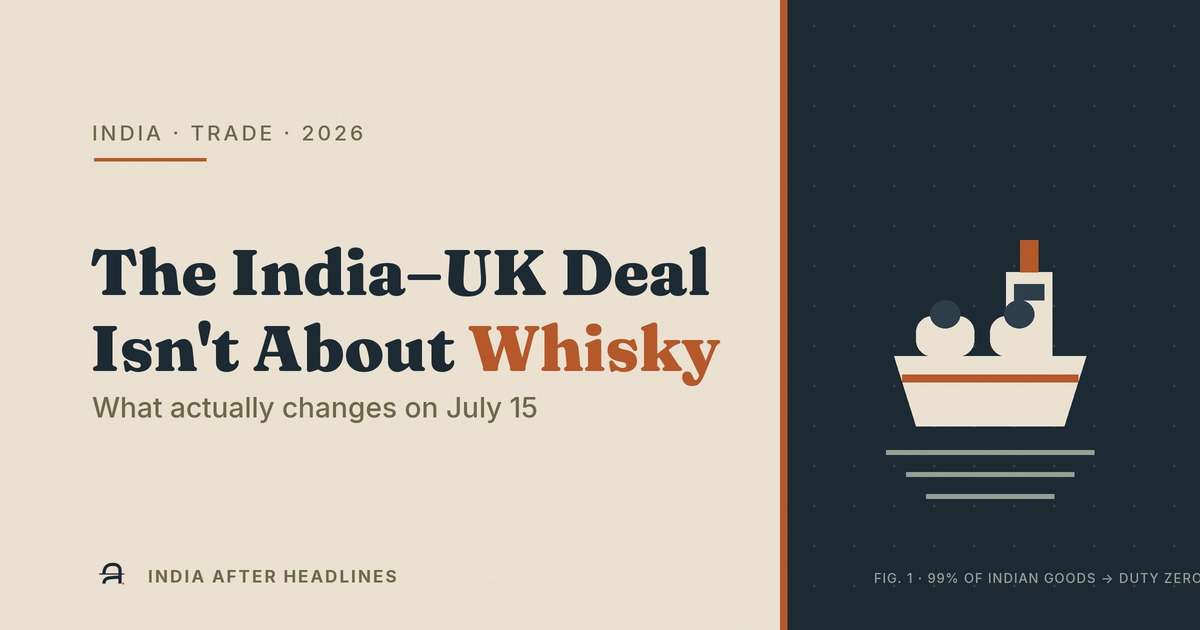
Short answer: The India–UK trade deal (in force 15 July 2026) is not mainly about cheaper whisky. From day one the UK removes duty on about 99% of Indian goods — textiles, leather, marine products, gems, engineering goods and pharma — and that export demand is the real, immediate win because it supports jobs. A second win, the Double Contribution Convention, lets Indians on UK postings of up to five years (raised from three) skip UK social security, keeping roughly 25% more of their salary, which can go into their Indian PF. The much-hyped consumer cuts are phased and narrow: whisky duty drops 150%→75% now but reaches 40% only by year ten, and car duty falls to 10% only for vehicles above £40,000, under quota. And there’s a catch no headline shows: the UK’s 2027 CBAM carbon tax could tax India’s ~$775 million in steel and aluminium exports by an estimated 14–24%.
Everyone’s talking about the whisky
Look at a bottle of imported Scotch. Until now it carried a 150% import duty in India. From 15 July, that starts to fall — and that single fact is doing almost all the work in the coverage of this deal.
It’s the wrong thing to stare at. The whisky is the bait, not the story. What India actually traded for is bigger, quieter, and sitting a few lines below the headline.
The misconception: “India–UK deal = cheaper stuff for me”
That’s the instinctive read. It’s mostly wrong, in both directions — the consumer discounts are smaller and slower than advertised, and the genuinely large wins have nothing to do with your shopping cart.
Start with the discounts, because they’re the part everyone gets backwards. Whisky duty does fall — from 150% to 75% immediately — but the widely-quoted 40% figure is a year-ten number, arriving around 2036. UK car duties drop from over 100% to 10%, but only on cars priced above £40,000, and only within a quota of 20,000 vehicles in the first year. India deliberately left its cheaper mass-market and EV cars out of the deal, to protect domestic buyers and manufacturers. So unless your next purchase is premium single malt or a luxury import, “everything’s cheaper now” doesn’t describe your life.
The sourced answer: it’s a jobs story and a salary story
Here’s the part that deserves the headline and won’t get it.
From the first day, the UK eliminates duty on roughly 99% of Indian tariff lines. The cloth stitched in Tirupur, the leather worked in Agra and Kanpur, the fish and prawn from India’s coasts, the diamonds cut in Surat, engineering goods, pharmaceuticals — goods that until now paid 12%, 16%, 21%, sometimes up to 70% at the UK border — go to zero. Cheaper Indian goods sell more in Britain, and more sales means more orders back home, in exactly the labour-intensive sectors that employ millions. If someone in your family works in an export hub, this deal is tied directly to their wage. That is the story the whisky bottle is hiding.
The second win is buried in a boring three-letter clause: the Double Contribution Convention (DCC). Until now, an Indian sent to work in the UK paid UK social security there and PF in India — a double deduction on the same salary, for a stint they weren’t even settling into. The DCC ends that for temporary postings of up to five years (raised from three). Roughly 25% of salary that used to disappear into UK National Insurance now stays with the worker — and can flow into their Indian PF, where it compounds at about 8.25%, tax-free. The government estimates around 75,000 professionals and 900 companies benefit. It isn’t whisky. It’s a payslip.
The wry twist: the catch is written in a footnote
No deal is one-sided, and this one has a cost that no launch-day headline is showing you.
In 2027, the UK introduces CBAM — a Carbon Border Adjustment Mechanism, which is a polite name for a carbon tax on imports of high-emission goods like steel, aluminium, cement and fertiliser. India’s roughly $775 million in steel and aluminium exports — the very goods this FTA just made duty-free — could then face an estimated 14–24% carbon tax at the UK border. One door opens; in the next room, a new toll is waiting. India and the UK are still arguing about it. The fight isn’t over, and the full accounting of this deal lives in that footnote, not in the whisky aisle.
None of this makes the deal a bad one. It’s genuinely large — India’s first trade agreement of this scale with a major Western economy — and where the India–US deal is still stuck, this one actually closed. Both governments earned it. The point isn’t to be cynical about the deal. It’s to read the whole page instead of the headline.
What to actually do
- If you work in an export sector — or someone in your family does — expect order books to grow over the coming year, and treat it as an opening to prepare for, not a lottery to wait on.
- If a UK posting ever comes up, ask specifically about the DCC. Don’t quietly let 25% of your salary vanish into UK National Insurance out of habit; the exemption is now yours to claim for up to five years.
- When anyone tells you “it’s all cheaper now,” ask three questions: cheaper on what, from when, and inside which quota? The honest answers are “a few premium things,” “slowly,” and “capped.”
- Keep half an eye on CBAM through 2027. If you’re anywhere near the steel, aluminium or metals trade, the carbon tax is the number that decides whether this deal’s gain survives.
The whisky bottle was the easy story, which is why it became the headline. But money reaches your home through work and through salary — and those two things were sitting quietly below the fold the whole time.
Sources
- gov.uk — UK–India trade deal, entry into force 15 July 2026 (business.gov.uk campaign)
- gov.uk — UK–India Double Contributions Convention (DCC) explainer
- House of Commons Library — UK–India Free Trade Agreement briefing
- Business Standard — India–UK trade pact: what changes for autos, whisky, textiles, steel
- Business Standard — India–UK pact: 5-year social security relief to aid 75,000 workers
- Business Today — UK–India FTA in force July 15; whisky tariffs to fall 150% to 40%
- The Federal — duty-free access for all exports from July 15 (Piyush Goyal)
- Daily Pioneer — steel and CBAM the sticking point in India–UK trade pact
- NextIAS — steel quotas and carbon barriers in the India–UK FTA
When does the India–UK free trade agreement start?
The India–UK Comprehensive Economic and Trade Agreement (CETA) and the accompanying Double Contribution Convention (DCC) come into force on 15 July 2026. The deal was signed on 24 July 2025; 15 July 2026 is the date it actually takes effect.
What gets cheaper for Indian consumers under the India–UK FTA?
Less, and more slowly, than the headlines suggest. Duty on UK whisky and gin drops from 150% to 75% immediately, but only reaches 40% by the tenth year of the deal. UK car duties fall from over 100% to 10%, but only for vehicles priced above £40,000 and within an annual quota (20,000 cars in year one). India deliberately kept its cheaper mass-market and EV cars out of the concession. So premium Scotch and luxury cars get cheaper gradually; everyday goods largely don't.
How does the India–UK deal help Indian workers?
In two ways. First, from day one the UK removes duty on about 99% of Indian goods — textiles, leather, marine products, gems, engineering goods and pharma — which raises demand and, with it, jobs in those export sectors. Second, the Double Contribution Convention means Indians on temporary UK assignments of up to five years (raised from three) no longer pay UK social security, so roughly 25% of salary that used to be deducted now stays with the worker, and can go into their Indian PF.
What is the Double Contribution Convention (DCC)?
It's the social-security half of the deal. Until now, an Indian posted to the UK paid UK National Insurance there and PF in India — a double deduction. The DCC exempts Indian workers and employers from UK social-security contributions during temporary postings of up to five years. The government estimates around 75,000 professionals and 900 companies will benefit.
What did India protect in the deal?
India kept sensitive sectors out of the concessions — dairy, apples and edible oils among the agricultural exclusions — and shielded its domestic auto market by excluding cars priced below £40,000. The tariff cuts on whisky and cars are also phased over years rather than immediate, giving domestic industry time to adjust.
What is CBAM and why does it matter for the India–UK deal?
CBAM is the UK's Carbon Border Adjustment Mechanism, a carbon tax on imports of high-emission goods like steel, aluminium, cement and fertiliser, due to start in 2027. India's roughly $775 million in steel and aluminium exports — which this FTA just made duty-free — could face an estimated 14–24% carbon tax under CBAM on full phase-out. India and the UK are still negotiating it, so part of the FTA's gain for metals could be clawed back.
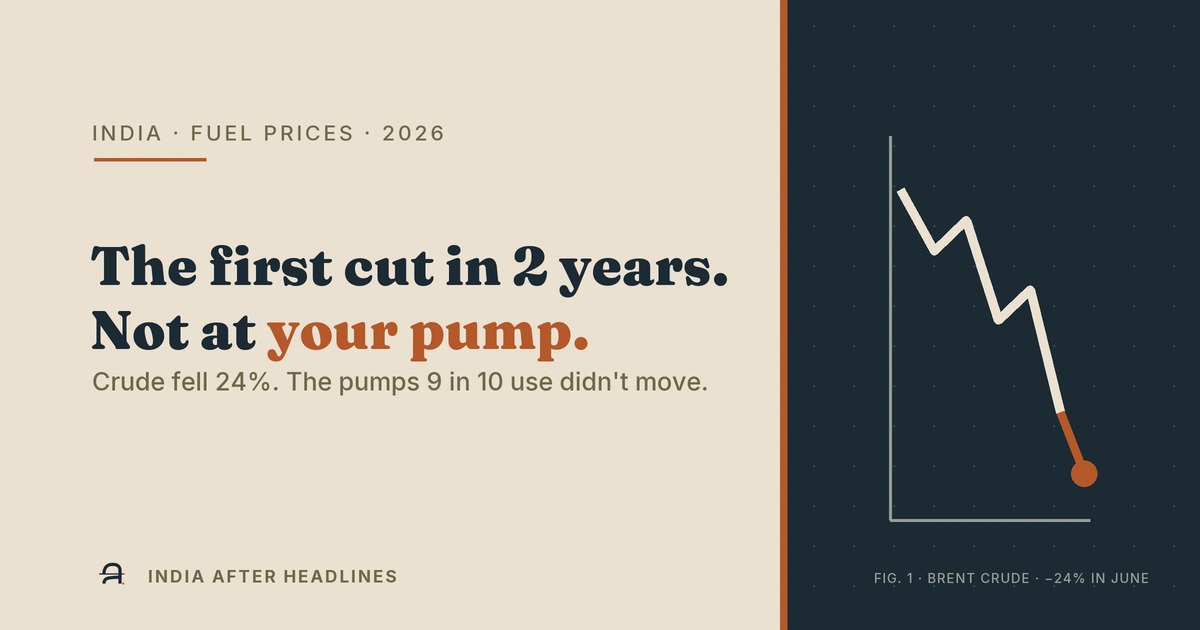
Petrol Just Got ₹5 Cheaper in India — for the First Time in 2 Years. So Why Is Your Pump Still Charging ₹102?
Crude crashed 24% in a month. One retailer cut prices. The pumps 9 out of 10 of us use didn't move a paisa. The gap between those two facts is the whole story.
From 1 July 2026, Your Credit-Card Reward Points Quietly Drop to Zero on the Spends You Use Most
A 'terms updated' email feels like a non-event. For the points you've been quietly banking on bills, UPI, insurance and school fees, it isn't.
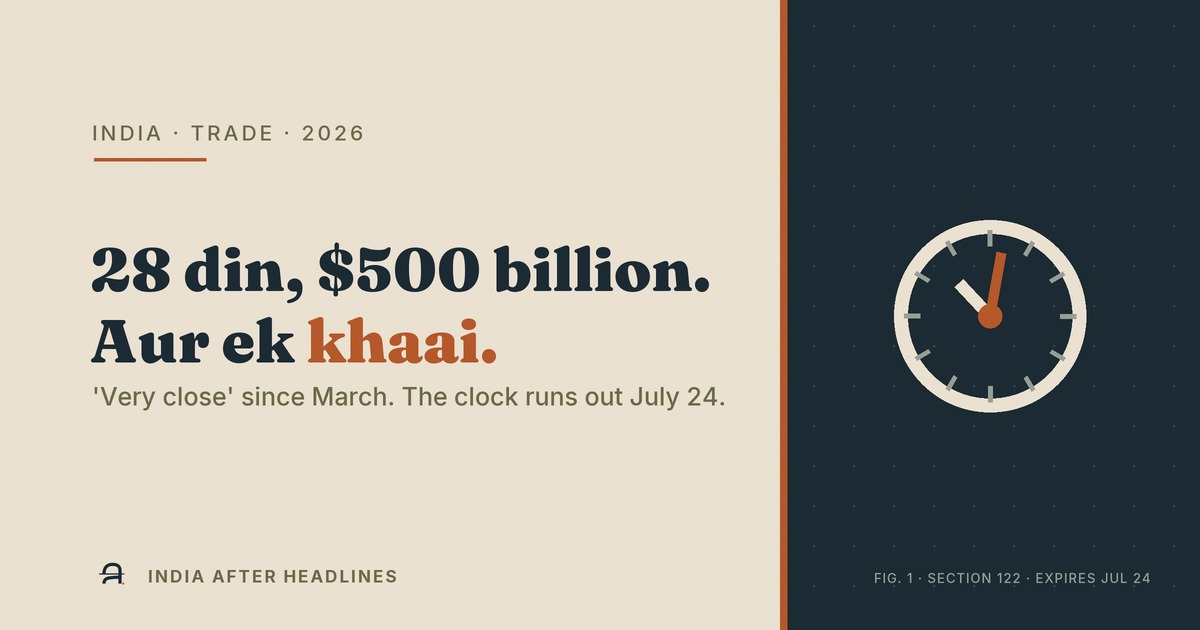
India-US Trade Deal Is 'Very Close' — So Why Hasn't It Been Signed?
Both sides want it. Nobody will sign it. The clock runs out on July 24.