
Did GST Actually Make Things Cheaper in India? Yes — So Why Didn't Your Bill Drop?
Roughly 375 things got officially cheaper. Your month-end pocket never got the memo. Both facts are true — and the gap between them is the whole story.
Short answer: Yes — and the proof is sitting in your own bathroom. From 22 September 2025, India collapsed its four messy GST slabs (5, 12, 18, 28%) into two — 5% and 18% — plus a 40% rate reserved for luxury and sin goods. About 375 goods and services got cheaper on paper. Your soap, shampoo, butter and packaged food moved to 5%; big durables like ACs, large TVs, washing machines and small cars fell from 28% to 18%. So the prices fell. The question that actually matters is why your month-end pocket never felt it.
Look around your house — almost everything is officially cheaper
The same soap, the same shampoo, the same Amul butter, the same fridge, the same two-month-old TV. Over the last few months, the tax on nearly all of it quietly came down. This isn’t a rumour you have to take on faith — the companies announced it themselves. HUL cut prices on brands like Dove and Lifebuoy. Amul cut prices across more than 700 items — butter, ghee, paneer, cheese, ice cream.
A ten-point drop on a big-ticket item — 28% to 18% on an AC or a large TV — is not a small thing. So if all of this got cheaper, where did the money in your hand go?
So why is your monthly spending exactly the same?
Here’s the uncomfortable mechanics. The tax came down. The full saving didn’t reach you as savings. Three things ate the gap:
- Margin. In some places the company simply widened its own margin and kept the difference.
- The shopkeeper. In some places the retailer kept the old price on the shelf.
- The other direction. Some costs — services, rent, fuel — kept rising, which made your total bill look flat even as goods got cheaper.
The government opened the door. Whether the full amount reached the room depended entirely on who was standing in the doorway.
Is this a government con? No.
It’s worth being fair here, because the cynical read is the wrong one. The intent of the reform was clean: lighten the ordinary household’s basket and lift spending. The villain isn’t a person. It’s that empty gap — the space between the tax cut on paper and the number printed on your receipt. Blame the gap, not a conspiracy.
A tax cut is a permission slip, not a refund. The government can lower the price. Getting it into your pocket is a separate job — and that job is yours.
What to do
- Pull out your old bills. For the big purchase you’ve been planning — TV, AC, fridge — check that today’s GST rate is 18%, not 28%. That ten-point gap is real money on a large item.
- Read the fine print on everyday goods. Look for 5% printed under the MRP on essentials. If the printed price hasn’t moved despite the lower slab, that’s your cue to ask why.
- Ask the question out loud. Where the saving hasn’t been passed on, the seller is the one standing in the doorway. The cut becomes yours only when you claim it.
Sorting out your take-home? See also: Is a ₹12 lakh salary really tax-free in 2026? — the rebate most people misread.
Take action
Sources
- GST Council / CBIC — two-slab GST structure (5% & 18%) effective 22 September 2025
- HUL — price revisions on Dove, Lifebuoy and other brands following GST cut, 2025
- Amul (GCMMF) — price cuts across 700+ products post-GST reform, 2025
- Press Information Bureau — GST rate rationalisation, list of goods moved to lower slabs
Did GST actually make things cheaper in 2026?
Yes, on paper. From 22 September 2025 India moved to two main GST slabs — 5% and 18% — plus a 40% rate on luxury and sin goods. About 375 goods and services moved to a lower tax rate. Everyday items like soap, shampoo, butter and packaged food sit at 5%, and big durables like ACs, large TVs, washing machines and small cars fell from 28% to 18%.
If GST was cut, why hasn't my monthly bill come down?
Because a tax cut and a price cut are not the same thing. The lower tax opened room for lower prices, but how much reached you depended on who stood in between — some companies widened their margins, some shops kept the old printed price, and rising costs elsewhere (services, rent, fuel) offset the savings on goods. The cut was real; the full pass-through was uneven.
Which goods became cheaper under the new GST slabs?
Everyday essentials — soap, shampoo, toothpaste, butter, paneer, packaged food — moved to the 5% slab. Large durables that were taxed at 28% — air conditioners, large TVs, washing machines, dishwashers, small cars and bikes under 350cc — dropped to 18%, a ten-point cut on big-ticket purchases.
How do I make sure I get the GST saving?
Check the GST rate on your own receipts. On a planned big purchase (TV, AC, fridge), confirm the rate is now 18%, not 28%. On everyday goods, look for 5% printed under the MRP. Where the price hasn't fallen despite the lower tax, ask the seller why — the saving only reaches you if you claim it.
The India–UK Trade Deal Isn't About Cheaper Whisky
The headline is Scotch. The real money is in export jobs, a five-year salary waiver, and a 2027 carbon tax nobody's showing you.
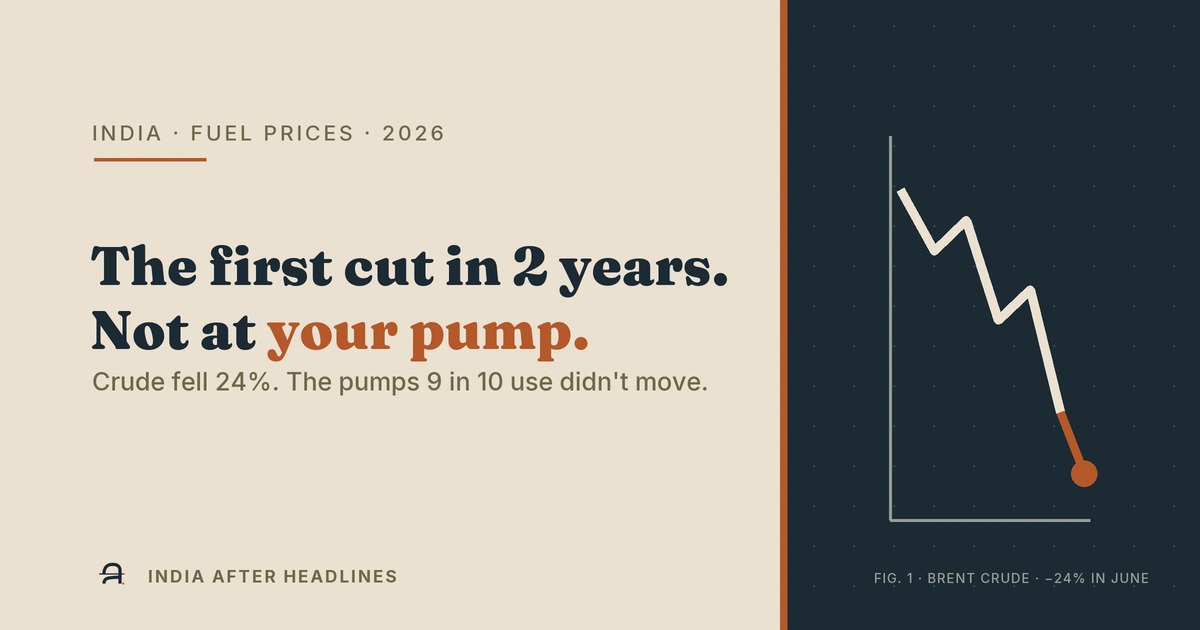
Petrol Just Got ₹5 Cheaper in India — for the First Time in 2 Years. So Why Is Your Pump Still Charging ₹102?
Crude crashed 24% in a month. One retailer cut prices. The pumps 9 out of 10 of us use didn't move a paisa. The gap between those two facts is the whole story.
From 1 July 2026, Your Credit-Card Reward Points Quietly Drop to Zero on the Spends You Use Most
A 'terms updated' email feels like a non-event. For the points you've been quietly banking on bills, UPI, insurance and school fees, it isn't.