
Why Is the Market Falling and Should You Stop Your SIP? The 2026 Crash, Honestly
Your SIP turned red overnight and you did nothing. A voice says sell. That voice is working for someone else — and it isn't you.
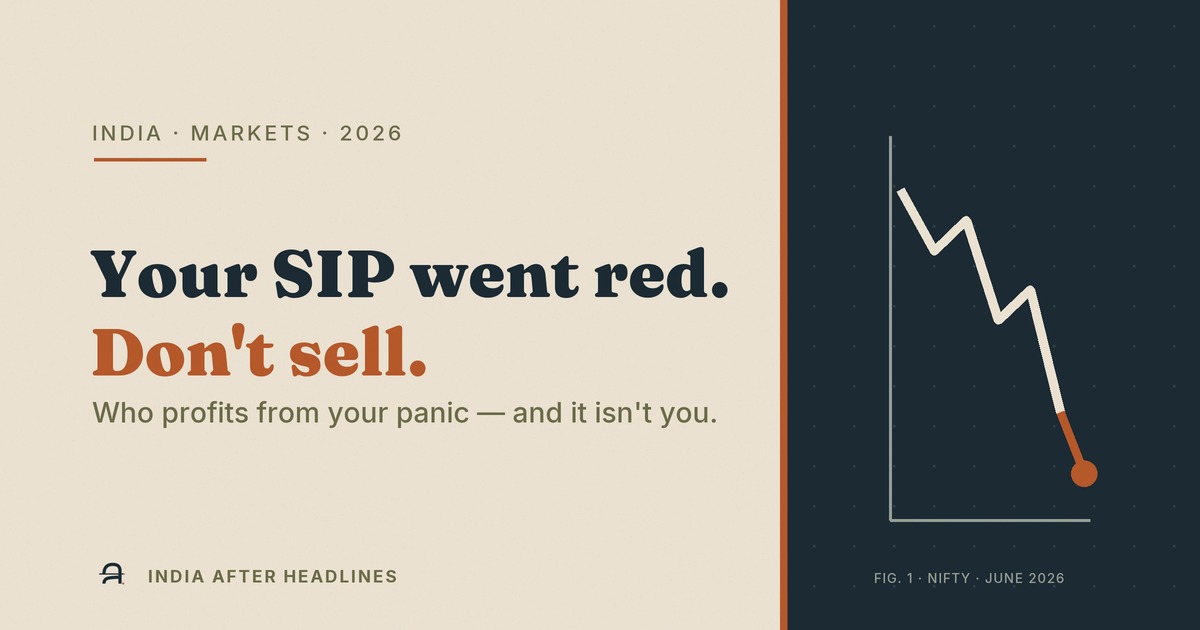
Short answer: Don’t press sell. Your SIP turned red overnight not because anything broke in India, but because of a panic seven seas away. On Friday 5 June 2026, the US Nasdaq fell ~4.18% and roughly $1 trillion was wiped off Wall Street in a single day — an AI chip-stock scare (Broadcom, Marvell, Micron) plus a too-strong US jobs report that raised fears the Federal Reserve will hike rates instead of cutting. That fear pulled foreign money out of India, dragged the indices your funds track, and landed — cold — in your portfolio by Monday morning. You bought nothing. The bill arrived anyway.
You did nothing — and the number still shrank
No Indian company failed. Your salary came. Your job is the same. You were asleep. And yet the SIP you’ve fed for years — the school fees, the down payment, the retirement — is visibly smaller than it was on Friday. The building WhatsApp group is already loud: “down ten percent,” “sell everything, it’ll fall further.” That voice — sell, save whatever’s left — is the one to be suspicious of. Because if you act on it, you do to yourself exactly what someone else needs you to do.
How does a crash in America reach your tea?
Follow the chain, because this is your story:
- One line, one trillion. A chip company said AI-chip demand won’t grow as fast as assumed. Shares that had soared on AI hype crashed in a day. The US “fear thermometer” (VIX) jumped 40%.
- Good news read as bad. The US added 172,000 jobs in May — strong. A strong economy means the Fed might raise rates, and when America raises rates, global money rushes there for a safer return.
- Foreign money flees India. Frightened foreign institutional investors (FIIs) sold ₹21,105 crore of Indian shares on Friday alone — over $11 billion across 2026, more than they pulled in all of last year.
- The rupee falls. To carry that money home in dollars, they sell rupees — pushing the rupee to a record low near ₹95.43 to the dollar.
One sentence in California → their shares fell → fear rose → foreign money left India → your SIP went red. You never touched an American share.
Both sides are true — and one of them protects you
The fear isn’t fake: some stocks really had grown too expensive on AI hype, US rate risk is real, and foreign money really is leaving. But nothing broke inside India. Corporate profits held, banks are fine, the economy is running. This was imported fear, not domestic weakness.
And here’s what no panicked WhatsApp message will tell you: this time, the buffer is you. Every month about ₹32,000 crore flows into the market through SIPs — 9.65 crore SIP accounts. Domestic funds put over ₹5 lakh crore in this year. That money — money from people exactly like you — is soaking up the foreign exit. The market used to dance to a foreign mood; today your own money stands inside it, steadying it.
The market didn’t take your money. Fear borrowed it. And that loan only comes back to the people who don’t open their hands in panic at the bottom.
This isn’t only about your SIP
If you work in IT, read this twice. A large share of Indian IT’s earnings comes from America. When the US talks about spending less on AI and tech, your next appraisal, the next hiring round, the next project all feel it. This episode touches some salary slips, not just folios — which is exactly why understanding it beats reacting to it.
What to do on Monday morning
- Don’t sell into the fall. Redeeming a long-term SIP at the bottom converts a paper loss into a permanent one — and the recovery happens without you.
- Let the SIP do its job. A falling market is when a SIP quietly buys more units for the same money. Pausing it cancels the one advantage you have.
- Separate noise from need. Decide on your goal and your timeline, not the red number or the group chat. The person who understands the chain above doesn’t press the wrong button at the wrong time.
The same imported fear is freezing another big decision: Should you buy a house in India in 2026? — where job worry, not weak demand, stalled the market.
Take action
Sources
- Nasdaq / Wall Street — 4.18% fall and ~$1 trillion wiped on 5 June 2026 (AI chip-stock selloff: Broadcom, Marvell, Micron)
- US Bureau of Labor Statistics — May 2026 jobs report (172,000 jobs added)
- NSDL / NSE — FII equity outflows: ₹21,105 crore on 5 June 2026; >$11 billion in 2026
- RBI — rupee at record low near ₹95.43/$, June 2026
- AMFI — monthly SIP inflows (~₹32,000 crore/month) and 9.65 crore SIP accounts
Why is the Indian stock market falling right now?
Not because anything broke inside India. On 5 June 2026 the US Nasdaq fell about 4.18% and roughly $1 trillion was wiped off Wall Street, driven by a panic in AI chip stocks (Broadcom, Marvell, Micron) and a stronger-than-expected US jobs report that raised fears of higher US interest rates. That fear pushed foreign investors to pull money out of emerging markets like India, dragging Indian indices and SIP values down with it.
How does a US crash reach my SIP in India?
Through a chain. US fear makes foreign institutional investors (FIIs) sell emerging-market shares — they sold ₹21,105 crore of Indian stocks on 5 June 2026 and over $11 billion in 2026. To take that money home in dollars they sell rupees, pushing the rupee to a record low near ₹95.43. Their selling drags down the same indices your mutual funds track, so your SIP value falls — even though you bought nothing.
Should I stop or redeem my SIP when the market crashes?
For a long-term goal, no. Selling at the bottom turns a paper loss into a real, permanent one and locks you out of the recovery. A SIP is designed to buy more units when prices are low. The fall in June 2026 came from imported fear, not from any failure inside India's economy or banks.
Is my mutual fund safe in this crash?
The fall reflects market prices dropping, not your fund company failing. Indian banks and corporate earnings held up through this episode. Crucially, domestic SIP money — about ₹32,000 crore flowing in every month across 9.65 crore accounts — is now absorbing much of the foreign selling, which cushions the kind of collapse seen in earlier foreign-money exits.
Does this affect IT jobs and appraisals too?
It can. A large share of Indian IT revenue comes from the US. When American firms signal they will spend less on AI and tech, it feeds through to hiring rounds, project pipelines and appraisals at Indian IT companies — so a US tech wobble touches some salary slips, not just investment portfolios.

The India–UK Trade Deal Isn't About Cheaper Whisky
The headline is Scotch. The real money is in export jobs, a five-year salary waiver, and a 2027 carbon tax nobody's showing you.
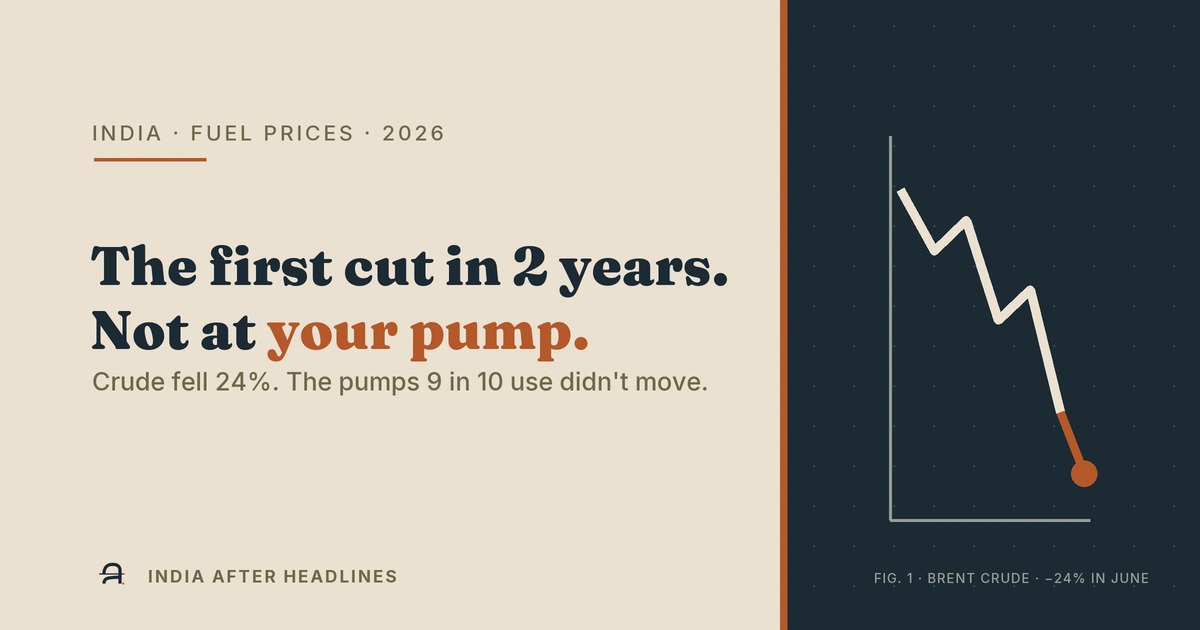
Petrol Just Got ₹5 Cheaper in India — for the First Time in 2 Years. So Why Is Your Pump Still Charging ₹102?
Crude crashed 24% in a month. One retailer cut prices. The pumps 9 out of 10 of us use didn't move a paisa. The gap between those two facts is the whole story.
From 1 July 2026, Your Credit-Card Reward Points Quietly Drop to Zero on the Spends You Use Most
A 'terms updated' email feels like a non-event. For the points you've been quietly banking on bills, UPI, insurance and school fees, it isn't.